Week 5 marks the half way point in the 10 week quarter. Midterms were this week and now the calm before the storm. With just a couple weeks until concert season, finals, and projects/papers are due.
Opera Scenes- I am in a duet from Puccini's Suor Angelica with another grad student. I am the princess coming to tell her niece, Sister Angelica, that I want her to sign papers forfeiting her inheritance. It is a beautiful scene with a lot of passion and drama. Classic Puccini. We have to have the entire scene memorized by the 5th. And the performance is later this month. http://www.youtube.com/watch?v=Jqzz_gOsGC0
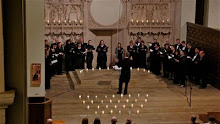
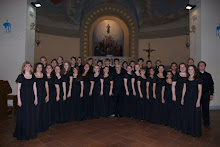
Chamber Choir- We are performing parts of two rarely performed, yet gorgeous, Handel oratorios. Belshazzar and Solomon. Prof. Gervais gave me solos in each and I am loving studying these great choral works. The concert is later this month in a larger venue than we're used to.
Quire of Voyces- This season we're singing Christmas music. But, not Christmas music most people are familiar with. Including a new Mass by our resident composer Michael Eglin. I love his stuff. He is very talented.
Voice Lessons- I am working on several arias. Including one from Ponchielli's La Gioconda, suggested by my instructor. Stella del Marinar. I love it. My teacher is more and more convinced that I am a soprano. (Probably because in the beginning of my lessons she typically takes me up to high Cs.) So we're starting to look at some higher material. I was always resistant to sing soprano because my piano (soft dynamic) is not the same as other's piano. I am loud and have always been loud. So that range that I was always scared of was more a fear of my volume at such levels. Well obviously I need to work on singing high and piano (a matter of support) but I am no longer afraid of those notes. They are actually easier than the 4-5 notes immediately lower, that I used to consider the top of my range. So throughout Stella del Marinar I work extremely hard at all the technique intricacies and difficulties... until I get to the high last note. I don't have to worry about this note because it's the easiest. Kind of strange, I know. Recital coming this Spring. http://www.youtube.com/watch?v=kcCw8MWoBDg
Sunday, November 1, 2009

Sunday, October 11, 2009
Sing Sing Sing
What a couple of weeks! First, appropriately on the first day of the new quarter , after voice auditions and the voice department meeting, Ben Brecher (head of the voice department) got us in to the dress rehearsal for the world premiere of Stephen Schwartz's opera, Seance on a Wet Afternoon. Amazing! So creepy. Wonderful set and passionate singing. Very dramatic even if reminiscent of musical theater. Very enjoyable.

 , after voice auditions and the voice department meeting, Ben Brecher (head of the voice department) got us in to the dress rehearsal for the world premiere of Stephen Schwartz's opera, Seance on a Wet Afternoon. Amazing! So creepy. Wonderful set and passionate singing. Very dramatic even if reminiscent of musical theater. Very enjoyable.
Second, 5 days later, Kim Jepherson gave a masterclass at  UCSB. He was in Seance and was fantastic.
 UCSB. He was in Seance and was fantastic.
 Third, 2 days later, Stephen Schwartz came to  UCSB for an interview/Q&A session for the theater and music departments. I'm not a huge fan of most musical theater (Wicked included) but, he was very interesting. Not only did he write Godspell and Pippin :( but Prince of Egypt! :) As well as the lyrics for Pocahontas, Hunchback of Notre Dame and Enchanted. He said that he realizes that 98% of new operas never get performed after their premiere. He also said that he might write another in the future but doesn't have anything on the horizon.
 UCSB for an interview/Q&A session for the theater and music departments. I'm not a huge fan of most musical theater (Wicked included) but, he was very interesting. Not only did he write Godspell and Pippin :( but Prince of Egypt! :) As well as the lyrics for Pocahontas, Hunchback of Notre Dame and Enchanted. He said that he realizes that 98% of new operas never get performed after their premiere. He also said that he might write another in the future but doesn't have anything on the horizon.
Fourth, 6 days later, Thomas Hampson, world-class Baritone gave a lecture in association with the Library of Congress on American Song and a masterclass at UCSB that I was lucky enough to participate in. My friend Daniel Tuutau filmed it on his cell phone (is filmed the right word?) and I might be able to get it posted. Mr. Hampson talked a lot about hearing it like you want it to sound before opening your mouth, breath technique, posture, and balance, and having a clear understanding of what you and the music are portraying.
Fifth, that night, Thomas Hampson gave a recital for UCSB Arts and Lectures in Campbell Hall. Because I sang in the masterclass I received two tickets to that night's recital. They were front row center! He was wonderful! I've been to a lot of voice recitals but I had never been moved more. The highlights for me were 1, a setting of Lincoln's letter to Mrs. Bixby. So amazing and moving. 2, the setting of William Blake's Tiger, Tiger. I have heard many settings of this text and love to hear the different interpretations. This composer used heavy dissonance throughout until the stanza where the poet asks, "did He who make the lamb make thee?" Here the song became piano, lyrical and reverent. Of course, Thomas Hampson handled it beautifully. 3, Our new baritone teacher, Paul came up to sit by us (snuck up to the good seats) and pointed out to me on the program which pieces he thought I should look at. I was pretty stunned since he's only heard me sing twice, and flattered when I heard the songs and immediately knew I wanted to study them. and 4, the last highlight of the evening for me was when as his first encore he sang Shenandoah. The moment he started singing my tears started falling. It was the most amazing audience moment of my life. (Corny, I know. But true.) When he finished we leaped back to our feet and I realized that the 4 of us, Rebecca, Annie, Alyssa, and I were all crying! Too funny. What is this a Beetles concert? In Italy I shared a room with Blythe and Rebecca and one evening as we were getting ready for our concert we sang. One of the songs we sang was Shenandoah. I sang the melody and Blythe and Rebecca would improvise harmonies. I first learned Shenandoah back in vocal technique class at SBCC. Along with Danny Boy and The River is Wide I had the opportunity to study these American folk songs and have been able to sing them since. All of this adding to the experience of hearing Mr. Hampson sing such a hauntingly beautiful tune.
 in Campbell Hall. Because I sang in the masterclass I received two tickets to that night's recital. They were front row center! He was wonderful! I've been to a lot of voice recitals but I had never been moved more. The highlights for me were 1, a setting of Lincoln's letter to Mrs. Bixby. So amazing and moving. 2, the setting of William Blake's Tiger, Tiger. I have heard many settings of this text and love to hear the different interpretations. This composer used heavy dissonance throughout until the stanza where the poet asks, "did He who make the lamb make thee?" Here the song became piano, lyrical and reverent. Of course, Thomas Hampson handled it beautifully. 3, Our new baritone teacher, Paul came up to sit by us (snuck up to the good seats) and pointed out to me on the program which pieces he thought I should look at. I was pretty stunned since he's only heard me sing twice, and flattered when I heard the songs and immediately knew I wanted to study them. and 4, the last highlight of the evening for me was when as his first encore he sang Shenandoah. The moment he started singing my tears started falling. It was the most amazing audience moment of my life. (Corny, I know. But true.) When he finished we leaped back to our feet and I realized that the 4 of us, Rebecca, Annie, Alyssa, and I were all crying! Too funny. What is this a Beetles concert? In Italy I shared a room with Blythe and Rebecca and one evening as we were getting ready for our concert we sang. One of the songs we sang was Shenandoah. I sang the melody and Blythe and Rebecca would improvise harmonies. I first learned Shenandoah back in vocal technique class at SBCC. Along with Danny Boy and The River is Wide I had the opportunity to study these American folk songs and have been able to sing them since. All of this adding to the experience of hearing Mr. Hampson sing such a hauntingly beautiful tune.
Sixth, the next night, (tonight), Rebecca and I went to the METs live br oadcast, at the Music Academy of the West, of Puccini's Tosca. You know I love Puccini, and you know I love Tosca. This opera has three solid gold arias that you will find on any and all best of opera recordings. Puccini knows when to bring these achingly strong and gut-wrenching melodies back at just the right moment to remind us why his operas never left the standard repertoire and why Tosca is "the opera of operas."
 oadcast, at the Music Academy of the West, of Puccini's Tosca. You know I love Puccini, and you know I love Tosca. This opera has three solid gold arias that you will find on any and all best of opera recordings. Puccini knows when to bring these achingly strong and gut-wrenching melodies back at just the right moment to remind us why his operas never left the standard repertoire and why Tosca is "the opera of operas."
 I don't think I missed anything but it has been a great few musical weeks. I've seen some of the top singers in the world and have been a part of history in the making. And it all makes me want to hit the practice rooms and practice.
Friday, October 2, 2009
M.M. Voice
As my first week of grad school comes to a close I am finally getting my schedule set and an idea of what my quarter will look (and sound) like. A graduate student, in order to be full time, is required to take 8 units. I will have 23 units. Keep in mind that the performance courses are one unit. This means that choir, that rehearses 4 hours a week not to mention the outside time I will need to spend on my solos, is one unit. Opera scenes, that meets 4 hours a week and I will need to memorize and perform, is one unit. Who decided that opera production is one unit? Only twice the amount of credit as say jogging! What kind of wacko system is this? In opera production you still have to commit to memory the material, and be able to present it back learned. How is this less work than any other course? I digress.
I am taking the dreaded 200A course that all previous grad students have warned me about. Bibliography. I am exploring research sources and thinking about what topics I would like to focus on for my paper. It's a bibliographical paper, so basically a paper of every source on the entire planet, regardless of language, that discusses my topic. I was able to test my German and French reading skills this week when searching for articles in Le Grand Larrousse and Grosse Broeckhause encyclopedias. As voice majors we are encouraged to sing a variety of composers and a variety of periods. I find it hard to pick a favorite when I only work on small amounts of their repertoire. Now I have to pick a topic to focus on. Then yesterday, in class, she's going around the room and having each student share their topic. I've been trying to think, what musically do I love and would want to learn about above all else? Then it hit me... Mozart's Requiem. I absolutely love this work. It is one of my earliest introductions into sacred, choral music. I've performed it with the Santa Barbara Symphony and the Santa Barbara Chamber Orchestra with the Quire of Voyces. I realized this might be a little specific, so I started thinking about other settings of the Requiem text. Verdi's Dies Irae is AMAZING! I'm also thinking about the settings of the Gloria. Vivaldi's Gloria is THE reason I decided to major in music.
I am taking the dreaded 200A course that all previous grad students have warned me about. Bibliography. I am exploring research sources and thinking about what topics I would like to focus on for my paper. It's a bibliographical paper, so basically a paper of every source on the entire planet, regardless of language, that discusses my topic. I was able to test my German and French reading skills this week when searching for articles in Le Grand Larrousse and Grosse Broeckhause encyclopedias. As voice majors we are encouraged to sing a variety of composers and a variety of periods. I find it hard to pick a favorite when I only work on small amounts of their repertoire. Now I have to pick a topic to focus on. Then yesterday, in class, she's going around the room and having each student share their topic. I've been trying to think, what musically do I love and would want to learn about above all else? Then it hit me... Mozart's Requiem. I absolutely love this work. It is one of my earliest introductions into sacred, choral music. I've performed it with the Santa Barbara Symphony and the Santa Barbara Chamber Orchestra with the Quire of Voyces. I realized this might be a little specific, so I started thinking about other settings of the Requiem text. Verdi's Dies Irae is AMAZING! I'm also thinking about the settings of the Gloria. Vivaldi's Gloria is THE reason I decided to major in music.
Wednesday, July 15, 2009
EUROPE
 I just got back last week from our two weeks in Italy and my and Rebecca's week in Austria. (I'm going to post pictures as soon as I get organized.) I had such an amazing time. Italy is obviously beautiful and Vienna and Salzburg have their own charm. Tuscany is everything you imagine. In Austria it's green unless it's a rock. We kept ourselves on a strict schedule, trying to see as much as possible. I kept a running total of some of the more common things we did:
Churches Viewed~23
Towers Climbed~5
Concerts Performed~5
Concerts/Operas Watched~2
Forts Explored~3
Museums Patronized~14
Flights Endured~6
Trains Enjoyed~7
Cities Visited~Frankfurt, Siena, Monteroni, San Gimignano, Montepulciano, Montalcino, Chianti, Firenze (Florence), Buonconvento, Roma, Wien (Vienna), Salzburg, Werfen, Munich, and exotic Los Angeles.
Including the Colosseum, 3 homes of Mozart, viewing Michelangelo's David and the Pieta, the Vatican, and the Trevi Fountain.
Stay posted (get it), for more on my tour.
Wednesday, April 15, 2009
What goes into learning a song you ask?

Sometimes I forget how much non-singing is a part of singing. Sometimes I would like to just memorize notes and words, The End. But I know that isn't doing justice to me, the composer, librettist/poet, or the actual song/aria/recit. etc. So here is what is required of me as a voice major before I can even think about singing.
1. Research in the music library, by composer, trying to find a song that is in my range, fits in a set for my recital, is in a language I don't already have too many selections in, appropriate subject matter (for some reason I have a LOT of songs about death but that can have something to do with my range. Most often romantic love songs are written for soprano/tenor)
2. Listen to said selections. Do I like it? Fast or slow (I tend to have too many slow, death remember?), does it have interesting moments, etc.
3. Check out the score and make copies. One for me double sided to not take up too much space in my binder, one for my voice teacher, double sided for the folder he keeps in his office, and one for my voice coach, single-sided taped together and hole-punched (he has to be able to stretch it out if playing for me in a recital etc).
4. Write in a word for word translation. I have dictionaries in German, Italian, French, and Spanish. I also like Google Translate. I have also taken a year of Italian and Three and 1/2 years of German and am taking a year of French this Summer.
5. Do a poetic translation. Sometimes these are printed in the score, sometimes you have to look them up and sometimes you have to make up your own from the word for word (which is sometimes very difficult)
6. Write in the IPA (International Phoenetic Alphabet). You have to be able to pronouce it correctly. IPA Source.com is a good resource as well as the rules learned in that language's diction class.
7. Practice reading the text in English poetically and to tempo rhythmically
8. Practice reading the text in it's original language poetically and to tempo rhythmically
9. Research the composer. Putting this piece in context.
10. Research the poet/librettist
11.Do a basic tonal analysis
12. What is the form?
13. Look at phrases. How many? Where do they start and end? Where am I going to breathe?
14. Study the dynamics and other markings from the composer
15.Study the accompaniment. Is there a dialogue between singer and piano, is the piano a character, what is the piano doing, how is it similar or different to the voice and WHY?
16. Create a dramatic interpretation. What do I want to communicate with the audience? How can I make it interesting? How can I show or explain that deceptive cadence? etc.
17. Listen to recordings by different performers. See their take on the same song.
18. Learn the notes and rhythm.
19. Practice with correct vocal technique while applying all of the above.
20. Sing for my teachers prepared to apply their counsel
21. Memorize Above
I'm sure I missed something that I'll remember later. I occasionally have to remind myself that I really do like music. I like practicing and doing all of the above. I love it in fact and couldn't stop if I wanted to. Some of the songs I have found are now a part of my soul. (I know it's corny). How can we keep from singing?
Friday, April 10, 2009
Liederabend
Yesterday morning were Liederabend auditions. (A Liederabend is an old tradition of singers gathering in a home and singing German Lied-songs in the Abend-evening.) The voice department each year holds a Liederabend, to be performed in Lotte Lehman Concert Hall, selecting a different composer each year. Last year was Schubert and this year, Brahms. I have had the Flu all week and wasn't able to audition. But luckily I sang my Brahms selection for the faculty at my senior recital audition last week and they are having me close the Liederabend. For the piece it's perfect that I be last since it's his famous lullaby, Wiegenlied (Op. 49, No. 4.) Everyone knows the tune but perhaps not both German verses. This song is so beautiful. The poet describes this evening filled with roses and little carnations as you slip of to sleep. If God wills, you'll awake in the fair morning light. Angels will guard over you and show you in your dream a little Christ-child's tree. The second verse closes with the text, sleep now blissfully and sweetly in your dream's paradise. I just love it.
Wiegenlied:
Guten Abend, gut Nacht,
Mit Rosen bedacht,
Mit Näglein besteckt,
Schlupf unter die Deck':
Morgen früh, wenn Gott will,
Wirst du wieder geweckt.
Guten Abend, gut Nacht,
Von Englein bewacht,
Die zeigen im Traum
Dir Christkindleins Baum:
Schlaf nun selig und süß,
Schau im Traum's Paradies.
Lullaby:
Good evening, good night,
Bedecked with roses,
Covered with carnations,
Slip under the blanket
Early tomorrow, God willing,
Will you be woken again.
Good evening, good night,
Guarded by angels,
Who indicate to you by dream
The tree of the Christ child:
Sleep now blissfully and sweetly,
Behold Paradise in your dreams.
Wiegenlied:
Guten Abend, gut Nacht,
Mit Rosen bedacht,
Mit Näglein besteckt,
Schlupf unter die Deck':
Morgen früh, wenn Gott will,
Wirst du wieder geweckt.
Guten Abend, gut Nacht,
Von Englein bewacht,
Die zeigen im Traum
Dir Christkindleins Baum:
Schlaf nun selig und süß,
Schau im Traum's Paradies.
Lullaby:
Good evening, good night,
Bedecked with roses,
Covered with carnations,
Slip under the blanket
Early tomorrow, God willing,
Will you be woken again.
Good evening, good night,
Guarded by angels,
Who indicate to you by dream
The tree of the Christ child:
Sleep now blissfully and sweetly,
Behold Paradise in your dreams.
Saturday, April 4, 2009
Subscribe to:
Posts (Atom)