Wednesday, July 15, 2009

EUROPE

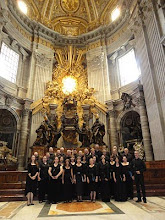
I just got back last week from our two weeks in Italy and my and Rebecca's week in Austria. (I'm going to post pictures as soon as I get organized.) I had such an amazing time. Italy is obviously beautiful and Vienna and Salzburg have their own charm. Tuscany is everything you imagine. In Austria it's green unless it's a rock. We kept ourselves on a strict schedule, trying to see as much as possible. I kept a running total of some of the more common things we did:

Churches Viewed~23
Towers Climbed~5
Concerts Performed~5
Concerts/Operas Watched~2
Forts Explored~3
Museums Patronized~14
Flights Endured~6
Trains Enjoyed~7
Cities Visited~Frankfurt, Siena, Monteroni, San Gimignano, Montepulciano, Montalcino, Chianti, Firenze (Florence), Buonconvento, Roma, Wien (Vienna), Salzburg, Werfen, Munich, and exotic Los Angeles.

Including the Colosseum, 3 homes of Mozart, viewing Michelangelo's David and the Pieta, the Vatican, and the Trevi Fountain.
Stay posted (get it), for more on my tour.

Wednesday, April 15, 2009

What goes into learning a song you ask?


Sometimes I forget how much non-singing is a part of singing. Sometimes I would like to just memorize notes and words, The End. But I know that isn't doing justice to me, the composer, librettist/poet, or the actual song/aria/recit. etc. So here is what is required of me as a voice major before I can even think about singing.
1. Research in the music library, by composer, trying to find a song that is in my range, fits in a set for my recital, is in a language I don't already have too many selections in, appropriate subject matter (for some reason I have a LOT of songs about death but that can have something to do with my range. Most often romantic love songs are written for soprano/tenor)
2. Listen to said selections. Do I like it? Fast or slow (I tend to have too many slow, death remember?), does it have interesting moments, etc.
3. Check out the score and make copies. One for me double sided to not take up too much space in my binder, one for my voice teacher, double sided for the folder he keeps in his office, and one for my voice coach, single-sided taped together and hole-punched (he has to be able to stretch it out if playing for me in a recital etc).
4. Write in a word for word translation. I have dictionaries in German, Italian, French, and Spanish. I also like Google Translate. I have also taken a year of Italian and Three and 1/2 years of German and am taking a year of French this Summer.
5. Do a poetic translation. Sometimes these are printed in the score, sometimes you have to look them up and sometimes you have to make up your own from the word for word (which is sometimes very difficult)
6. Write in the IPA (International Phoenetic Alphabet). You have to be able to pronouce it correctly. IPA Source.com is a good resource as well as the rules learned in that language's diction class.
7. Practice reading the text in English poetically and to tempo rhythmically
8. Practice reading the text in it's original language poetically and to tempo rhythmically
9. Research the composer. Putting this piece in context.
10. Research the poet/librettist
11.Do a basic tonal analysis
12. What is the form?
13. Look at phrases. How many? Where do they start and end? Where am I going to breathe?
14. Study the dynamics and other markings from the composer
15.Study the accompaniment. Is there a dialogue between singer and piano, is the piano a character, what is the piano doing, how is it similar or different to the voice and WHY?
16. Create a dramatic interpretation. What do I want to communicate with the audience? How can I make it interesting? How can I show or explain that deceptive cadence? etc.
17. Listen to recordings by different performers. See their take on the same song.
18. Learn the notes and rhythm.
19. Practice with correct vocal technique while applying all of the above.
20. Sing for my teachers prepared to apply their counsel
21. Memorize Above
I'm sure I missed something that I'll remember later. I occasionally have to remind myself that I really do like music. I like practicing and doing all of the above. I love it in fact and couldn't stop if I wanted to. Some of the songs I have found are now a part of my soul. (I know it's corny). How can we keep from singing?

Friday, April 10, 2009

Liederabend

Yesterday morning were Liederabend auditions. (A Liederabend is an old tradition of singers gathering in a home and singing German Lied-songs in the Abend-evening.) The voice department each year holds a Liederabend, to be performed in Lotte Lehman Concert Hall, selecting a different composer each year. Last year was Schubert and this year, Brahms. I have had the Flu all week and wasn't able to audition. But luckily I sang my Brahms selection for the faculty at my senior recital audition last week and they are having me close the Liederabend. For the piece it's perfect that I be last since it's his famous lullaby, Wiegenlied (Op. 49, No. 4.) Everyone knows the tune but perhaps not both German verses. This song is so beautiful. The poet describes this evening filled with roses and little carnations as you slip of to sleep. If God wills, you'll awake in the fair morning light. Angels will guard over you and show you in your dream a little Christ-child's tree. The second verse closes with the text, sleep now blissfully and sweetly in your dream's paradise. I just love it.

Wiegenlied:
Guten Abend, gut Nacht,
Mit Rosen bedacht,
Mit Näglein besteckt,
Schlupf unter die Deck':
Morgen früh, wenn Gott will,
Wirst du wieder geweckt.
Guten Abend, gut Nacht,
Von Englein bewacht,
Die zeigen im Traum
Dir Christkindleins Baum:
Schlaf nun selig und süß,
Schau im Traum's Paradies.

Lullaby:
Good evening, good night,
Bedecked with roses,
Covered with carnations,
Slip under the blanket
Early tomorrow, God willing,
Will you be woken again.
Good evening, good night,
Guarded by angels,
Who indicate to you by dream
The tree of the Christ child:
Sleep now blissfully and sweetly,
Behold Paradise in your dreams.

Saturday, April 4, 2009

Must the Winter Come so Soon by Samuel Barber

Italian Tour


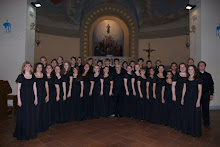
Did I mention the UCSB Chamber Choir is touring Italy this summer? I am so excited. Two weeks of singing in Italy! What could be better? This week in choir he gave us our proposed schedule. Check it out.~

June 15: LAX-Rome

June 16: Rome-Siena

June 17: rehearsals, Siena

June 18: rehearsals, Siena

June 19: concert, Chianti-Greve?

June 20: concert, e di Corsano?

June 21: concert, Siena

June 22: free day, Siena

June 23: free day, Florence

June 24: concert, Florence

June 25: free day, Florence

June 26: concert, Pienza

June 27: concert, Montalcino?

June 28: concert, Rome

June 29: free day, Rome

June 30 free day, Rome


Professor Gervais told us we might add a concert in Piza. Also, my friend Rebecca and I are staying longer. I'm only staying a week longer because I have to get back to Santa Barbara for my best friend's wedding. (Isn't that a movie?) We're going to continue our travels to Milan, Vienna, and Prague. My flight home will be from Frankfurt so I am also excited to see some of Germany as well. This trip will be amazing. If you have any travel tips, European travel tips, or ideas of things that I must see or do let me know. I would love advice. The timing of this tour is also perfect as I'll walk in graduation the day before we leave, making this trip a nice graduation trip as well.

Friday, April 3, 2009

My Program Bio

Stephanie Turner a native of Santa Barbara, transferred to UCSB from Santa Barbara City College where she majored in music and sang with the SBCC Concert Choir and the Chamber Singers. She performed solos for many works including Mozart’s Coronation Mass, Vivaldi’s Gloria, Haydn’s Mass in D, Gwyneth Walker’s The Christ Child Lullaby, Mozart’s Dixit Dominus, Benjamin Britten’s A Ceremony of Carols, as well as Broadway works and spirituals. While attending SBCC she was accepted into the applied music program where she studied voice with Andriana Kolendrianos. Each Christmas season, Stephanie is invited to sing in Disneyland’s Candlelight Procession. She was also invited to sing in the performance of Mozart’s Requiem at the Arlington Remembering September 11th. Stephanie currently sings with several local choirs including the UCSB Chamber Choir, the Santa Barbara Quire of Voyces, and the Goleta Valley Ward Choir of the Church of Jesus Christ of Latter-Day Saints. She studied for two years with Steven Kronauer and is currently studying with Susana Poretsky. In 2006 she toured England with the Quire of Voyces. Stepahnie participated in vocal performance workshops with Eduardo Villa at SBCC, and David Daniels at UCSB. Stephanie has received scholarships from the California Women’s Chorus, ASAP, and a UCSB Music Affiliates Excellence-at-Entrance award. In 2007 she played the second woman in Purcell’s Dido and Aeneas for The Opera Theatre at UCSB. The following season Stephanie sang the lead role of Mauyra in Ralph Vaughan Williams’ Riders to the Sea. In Summer 2008 she appeared in the Music Academy of the West’s production of William Bolcom’s A Wedding. Stephanie also had the role of Vincenza Biscroma in the 2009 UCSB Opera production of Gaetano Donizetti’s Le Convenienze e le Inconvenienze Teatrali, Viva La Mamma. In addition to singing Stephanie enjoys composing, teaching voice and piano, and playing the flute and violin.

Opera's Greatest Moments


I can think of at least three things wrong with this title. Ok not really. But I just checked this CD out of the library and was surprised by the selections found on and omitted from this album. The description reads, "Favorite selections from the world's best-loved operas." (Please excuse all lack of accents, umlauts, etc.)
1. Verdi: La Traviata: Libiamo, ne' lieti calici
2. Puccini: Gianni Schicchi: O mio babbino caro
3. Rossini: Il Barbiere di Siviglia: Largo al factotum
4. Bizet: Les Pecheurs des perles: Au fond du temple saint
5. Puccini: La Boheme: Mi chiamano Mimi
6. Tchaikovsky: Pique Dame: Yeltsky's Aria
7. Catalani: La Wally:Ebben? Ne andro lontano
8. Donizetti: L'elisir D'amore: Una furtiva lagrima
9. Wagner: Die Walkure: Du bist der Lenz
10. Verdi: La Forza del Destino: Pace, pace, mio Dio
11. Leoncavallo: Pagliacci: Vesti la giubba
12. Mozart: Le Nozze di Figaro: Dove sono i bei momenti
13. Verdi: Rigoletto: La donna e mobile
14. Puccini: Madama Butterfly: Un bel di vedremo
15. Mozart: Die Zauberflote: Ach, ich fuhl's
16. Verdi: Aida: Se quel guerrier io fossi; Celeste Aida
17. Bizet: Carmen: L'amour est un oiseau rebelle (Habanera)
18. Puccini: Turandot: Nessun Dorma
Well, whose favorite selections? How are these operas valued? Frequency of production? Most recorded? Highest ticket sales? Highest record sales? Top opera house's most frequent productions? I don't really want to argue the popularity of moments chosen because I can't deny their brilliance. Yet how can you decide to include Bizet's Habanera but leave off Saint-Saens' Mon coeur s'ouvre a ta voix? I'll be the first to agree that such a compilation should contain Pucinni's Un bel di vedremo, but why leave off his E Lucevan le Stelle? I guess the answer is that there is room for 18 selections. 18 tracks to sum up 400 years of opera. I guess if I was making the cd it would be called Stephanie's Favorite Opera Moments. I am by no means an opera aficionado, but here are the 18 of my favorite opera moments. (I'm going to try to include some non-Pucinni.)
1. Leoncavallo: Pagliacci: Vesti la giubba
2. Puccini: Madama Butterfly: Un bel di vedremo
3. Puccini: Gianni Schicchi: O mio babbino caro
4. Verdi: Il Trovatore: Vedi! Le Fosche Notturne Spoglie (Anvil Chorus)
5. Saint-Saens: Samson et Dalilah: Mon couer s'ouvre a ta voix
6. Mozart: The Marriage of Figaro: Sull'aria
7. Puccini:Tosca: E Lucevan le Stelle
8. Puccini: Tosca: Vissi D'arte
9. Pucinni: Tosca: Recondita Armonia
10. Puccini: La Rondine: Chi il bel sogno di Doretta
11. Dvorak: Rusalka: Song to the Moon
12. Verdi: La Traviata: Libiamo Ne'lieti Calici
13. Wagner: Tristan und Isolde: Mild und Leise
14. Donizetti: La fille du regiment: A mes amis
15. Bizet: Carmen: Votre Toast (Toreador's Song)
16. Bizet: Carmen: La fleur que tu m'avis jetee
17. Verdi: Il Trovatore: Stride la vampa
18. Offenbach: Les Contes d'Hoffmann: Belle Nuit, O Nuit d'Amour
19. Mozart: Die Zauberflote: Der Holle Rache
20. Puccini: La Boheme: O Soave Fanciulla
Ok so a lot are the same, and I ended up with 20, but what can I say? I'm a sucker for the big emotional moments. I don't get all weepy in movies since I started watching opera. When a movie reaches that point where it's trying to make me cry all I can think is "are they serious?" There is no comparison. (I would also recommend watching entire operas, not relying on the best of opera cds to aquire an appreciation.)What would you include on your favorite opera moments cd? Tune in next week for 18 best oratorio moments, followed by 18 best sacred choral and ballet moments.